
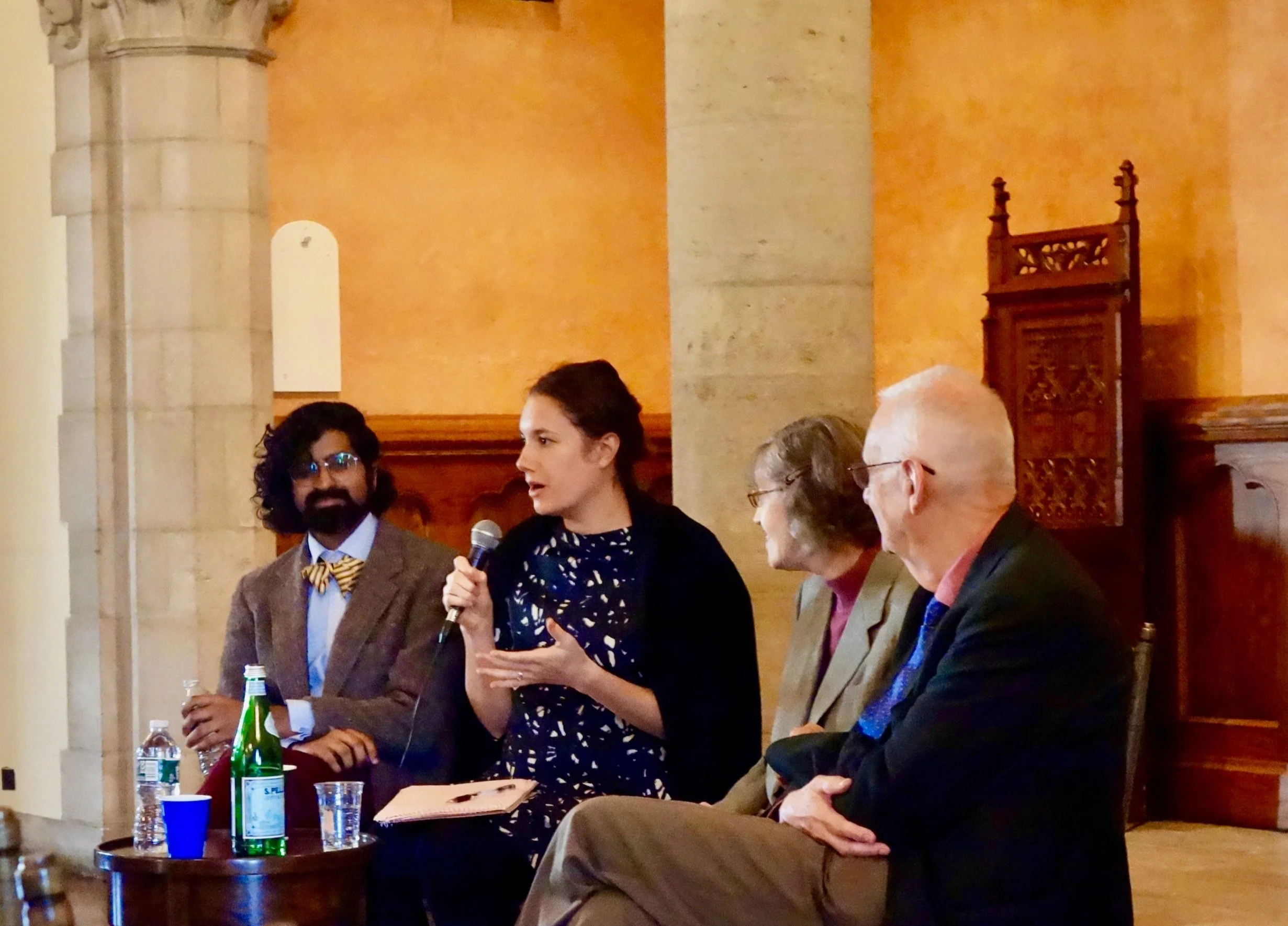
Long before humanoid robots look like us, we will be able to have conversations with our smartphones that will evoke from us all the empathy that adults habitually reserve for fellow human beings. That is, we will own assistants and companions that will feel to us like persons but (unlike pets) will be entirely at our disposal. With assistance from antiquity, and in engagement with such contemporary philosophers of mind as Daniel Dennett, Prof. Jordan Wales (Hillsdale) discusses how we might live humanely in a world of artificial intelligence by taking up four questions: First, how would an apparently personal AI work? Second, what might this entity be? Third, what might we become, owning apparent persons that are mere tools? Lastly, how might we live as owners of apparent persons in such a way as to enhance rather than to erode our own humanity?
The Arabic Roots of Medieval Scholasticism
The translation of Avicenna and other writers of the Islamic Golden Age into Latin was one of the most formative events in the history of Western Philosophy. Professor Therese Cory (Notre Dame) provides a glimpse of the “detective story” of how knowledge was transmitted from Muslim scholars to the European scholastics. She also discusses (24:48) how one particular idea from Averroes played an important part in the thought of St. Thomas Aquinas and continues to influence Christian theology today. As it turns out, the familiar claim that medieval scholastic philosophy was simply a rehash of Aristotle’s cannot be further from the truth.
This lecture was presented at the Morningside Institute on October 27, 2020.
Faith and the Big Bang Cosmos of Georges Lemaître
In 1930 the Catholic priest and physicist Georges Lemaître published a revolutionary view of the cosmos as one with a finite age and a definite beginning. But how he got there is as interesting a story as the idea of the Big Bang itself, and reveals just how profoundly this one man of faith and science set the stage for modern cosmology, the study of the universe’s origin and evolution.
Jonathan I. Lunine, David C. Duncan Professor in the Physical Sciences and chair of the department of Astronomy at Cornell University, tells the story of this extraordinary adventure. This lecture was given at the Morningside Institute on December 2, 2020.
The Error of Beginnings and the Beginning of Errors: Cosmology and Creation
This is the final lecture in a four-part series by Prof. William Carroll (Oxford) titled “Evolution, Cosmology, and Creation: From Darwin and Hawking to Aquinas”. This lecture explores recent developments in cosmology and the problems that would follow from identifying the concept of creation with that of a beginning. These lectures were presented from September 23 to October 14, 2020 at the Morningside Institute.
Transcendence, Providence, and Divine Agency in Nature
This is the third lecture in a four-part series by Prof. William Carroll (Oxford) titled “Evolution, Cosmology, and Creation: From Darwin and Hawking to Aquinas”. This lecture explores whether it is possible to have an idea of God as providential (i.e. as someone whose Will is never frustrated) in the context of an evolving universe of contingency and chance. These lectures were presented from September 23 to October 14, 2020 at the Morningside Institute.
Creation and a Self-Sufficient Universe
This is the second lecture in a four-part series by Prof. William Carroll (Oxford) titled “Evolution, Cosmology, and Creation: From Darwin and Hawking to Aquinas”. This lecture explores whether the autonomy of natural processes is compatible with God being the complete cause of all that is. These lectures were presented from September 23 to October 14, 2020 at the Morningside Institute.
The Challenges of Evolution and the Metaphysics of Creation
This is the first lecture in a four-part series by Prof. William Carroll (Oxford) titled “Evolution, Cosmology, and Creation: From Darwin and Hawking to Aquinas”. This lecture explores the challenges that evolutionary biology offers to the traditional doctrine of creation, and whether there can be a metaphysical view of creation distinct from the natural-scientific view. These lectures were presented from September 23 to October 14, 2020 at the Morningside Institute.
The City and Its Gods: Deus ex Machina: Byzantine Sanctuaries and Apple Stores
The second of two lectures by critic in architecture, Prof. Kyle Dugdale (Yale and Columbia). It is a commonplace of urban history to assert that the cities of antiquity belonged to their gods, and that those gods belonged to their cities. Athens belonged to Athena, and Athena to Athens, just as Babylon belonged to Marduk, and Marduk to Babylon. The city’s architecture reinforced those claims. But what of the modern city? Who are its tutelary deities, and where are its temples? In this two-part lecture series, Kyle Dugdale (Columbia and Yale) will explore how a city’s architecture reflects and shapes its ultimate concerns, setting the familiar realities of our contemporary urban environment against the backdrop of a longer historical narrative. Unfortunately we cannot publish Prof. Dugdale’s slides due to image copyrights, and we apologize for the poor audio quality.
The City and Its Gods: Seeking the Go(o)ds of the City, from Aristotle to Activism
Lecture by critic in architecture, Prof. Kyle Dugdale (Yale and Columbia)
It is a commonplace of urban history to assert that the cities of antiquity belonged to their gods, and that those gods belonged to their cities. Athens belonged to Athena, and Athena to Athens, just as Babylon belonged to Marduk, and Marduk to Babylon. The city’s architecture reinforced those claims. But what of the modern city? Who are its tutelary deities, and where are its temples? In this two-part lecture series, Kyle Dugdale (Columbia and Yale) will explore how a city’s architecture reflects and shapes its ultimate concerns, setting the familiar realities of our contemporary urban environment against the backdrop of a longer historical narrative.
Unfortunately we cannot publish Prof. Kyle’s powerpoint slides for the talk due to image copyrights.
The Stoic Roots of Augustine’s Conversion
Lecture by Prof. Sarah Byers (Boston College). What happened, exactly, in Augustine’s famous “conversion scene”? Professor Byers will show that Augustine is drawing on Stoic and Platonic epistemology and action theory to understand how divine grace acts on, and with, the human mind.
Do Bad Catholics Make for Good Fiction?
Novelist Randy Boyagoda, a professor of English at the University of Toronto, talks about what it means to create art and tell stories about pursuing the good as fallen persons. He discusses recent and classic examples of this phenomenon, and propose that there’s something distinctively possible to good storytelling in Catholic thought and practice.
Morality and Mortality in Willa Cather's Death Comes for the Archbishop | Sr. Ann Astell
This presentation by Sr. Ann Astell, Professor of Theology at the University of Notre Dame, was given as part of "The Moral Imagination of the Novel", a conference held at Columbia University on 4-5 October 2019.
The conference was co-hosted by the Morningside Institute, Columbia University's Department of Philosophy, and the Thomistic Institute. The program included lectures by Paul Elie (Georgetown), Lauren Kopajtic (Fordham), Dhananjay Jagannathan (Columbia), Sr. Ann Astell ( Notre Dame), and Thomas Pavel (Chicago).
For more information about this and other events, please visit MorningsideInstitute.org.
Fiction and Moral Reflection | Thomas Pavel
This presentation by Professor Thomas Pavel (University of Chicago) was given as part of "The Moral Imagination of the Novel", a conference held at Columbia University on 4-5 October 2019.
Professor Pavel is the Gordon J. Laing Distinguished Service Professor in Romance Languages and Literatures, Comparative Literature, the Committee on Social Thought, and Fundamentals at the University of Chicago.
The conference was co-hosted by the Morningside Institute, Columbia University's Department of Philosophy, and the Thomistic Institute. The program included lectures by Paul Elie (Georgetown), Lauren Kopajtic (Fordham), Dhananjay Jagannathan (Columbia), Sr. Ann Astell ( Notre Dame), and Thomas Pavel (Chicago).
For more information about this and other events, please visit MorningsideInstitute.org.
Etiquette and Morality in the Novel
This presentation by Spencer Lee Lenfield, PhD candidate in English at Yale University, was given as part of "The Moral Imagination of the Novel", a conference held at Columbia University on 4-5 October 2019.
The conference was co-hosted with Columbia University's Department of Philosophy, and included lectures by Paul Elie (Georgetown), Lauren Kopajtic (Fordham), Dhananjay Jagannathan (Columbia), Sr. Ann Astell ( Notre Dame), and Thomas Pavel (Chicago).
For more information about this and other events, please visit MorningsideInstitute.org.
The Anti-Moral Imagination Of Michel Houellebecq | Dhananjay Jagannathan
This presentation by Dhananjay Jagannathan, Assistant Professor of Philosophy at Columbia University, was given as part of "The Moral Imagination of the Novel", a conference held at Columbia University on 4-5 October 2019.
The conference was co-hosted by the Morningside Institute, Columbia University's Department of Philosophy, and the Thomistic Institute. The program included lectures by Paul Elie (Georgetown), Lauren Kopajtic (Fordham), Dhananjay Jagannathan (Columbia), Sr. Ann Astell ( Notre Dame), and Thomas Pavel (Chicago).
For more information about this and other events, please visit MorningsideInstitute.org.
‘Now, How Were His Sentiments to be Read?’ Imagination and Discernment in Jane Austin’s Persuasion | Lauren Kopajtic
The handout can be found here: http://bit.ly/36mEs
This lecture by Lauren Kopajtic, Assistant Professor of Philosophy at Fordham University, was given as part of "The Moral Imagination of the Novel", a conference held at Columbia University on 4-5 October 2019.
The conference was co-hosted by the Morningside Institute, Columbia University's Department of Philosophy, and the Thomistic Institute. The program included lectures by Paul Elie (Georgetown), Dhananjay Jagannathan (Columbia), Sr. Ann Astell ( Notre Dame), and Thomas Pavel (Chicago).
For more information about this and other events, please visit MorningsideInstitute.org.
The Need for a Christian Critical Tradition | William Gonch
This presentation by William Gonch, PhD candidate in English at University of Maryland, was given as part of "The Moral Imagination of the Novel", a conference held at Columbia University on 4-5 October 2019.
The conference was co-hosted by the Morningside Institute, Columbia University's Department of Philosophy, and the Thomistic Institute. The program included lectures by Paul Elie (Georgetown), Lauren Kopajtic (Fordham), Dhananjay Jagannathan (Columbia), Sr. Ann Astell ( Notre Dame), and Thomas Pavel (Chicago).
For more information about this and other events, please visit MorningsideInstitute.org.
Walker Percy's The Moviegoer Seen Again | Paul Elie
This lecture by Prof. Paul Elie (Georgetown) was given as part of "The Moral Imagination of the Novel", a conference held at Columbia University on 4-5 October 2019.
The conference was co-hosted by the Morningside Institute, Columbia University's Department of Philosophy, and the Thomistic Institute. The program included lectures by Lauren Kopajtic (Fordham), Dhananjay Jagannathan (Columbia), Sr. Ann Astell ( Notre Dame), and Thomas Pavel (Chicago).
For more information about this and other events, please visit MorningsideInstitute.org.
How Can I Say What I Never Knew? The Limits of Moral Knowledge in Great Expectations
This presentation by Catherine Enwright, PhD candidate in English at Boston College, was given as part of "The Moral Imagination of the Novel", a conference held at Columbia University on 4-5 October 2019.
The conference was co-hosted with Columbia University's Department of Philosophy, and included lectures by Paul Elie (Georgetown), Lauren Kopajtic (Fordham), Dhananjay Jagannathan (Columbia), Sr. Ann Astell ( Notre Dame), and Thomas Pavel (Chicago).
For more information about this and other events, please visit MorningsideInstitute.org.
The Crisis of Liberalism | Patrick Deneen and Vincent Phillip Muñoz
In light of the increasing tensions apparent in liberal societies, is liberalism an inherently contradictory system whose success generates its own downfall? Patrick Deneen elaborates on the argument of his new book Why Liberalism Failed and Vincent Phillip Muñoz responds.
This panel discussion, co-sponsored by The Portsmouth Institute and The University Bookman, took place in the Spring of 2019.